
How to Write a HVAC Service Technician Job Description
When hiring HVAC service technicians, many companies make the mistake of using a job description and a job ad interchangeably. While they are connected, they serve two very different purposes in the hiring process.
Understanding the difference can help you attract better candidates, create clearer expectations, and build a more structured recruiting process.
What’s the Difference Between a Job Description and a Job Ad?
A job description is the foundation. It’s a comprehensive internal document that outlines all the details and expectations of the role. This document is meant to clearly define the position for both the company and the employee.
A job description typically includes:
- Job title
- Reporting structure
- Work status
- Schedule
- Pay range
- Responsibilities
- Required qualifications
- Preferred qualifications
- Performance expectations
- Physical demands
- Advancement opportunities
This document should fully outline the role and serve as a guide for hiring, onboarding, training, coaching, and performance management.
On the other hand, a job ad is designed to market the position and attract applicants.
Think literal job ADVERTISEMENT – meant to catch someone’s attention and get them to apply.
The job ad takes the most important information from the job description and turns it into an advertisement for the role. Since the goal is to capture attention and encourage candidates to apply, it should be much shorter and easier to read. Bullet points are your friend here.
A strong HVAC job ad should:
- Start with the location and pay range
- Clearly list benefits
- Highlight key responsibilities
- Summarize qualifications
- Use bullet points instead of long paragraphs
- Be concise and easy to skim
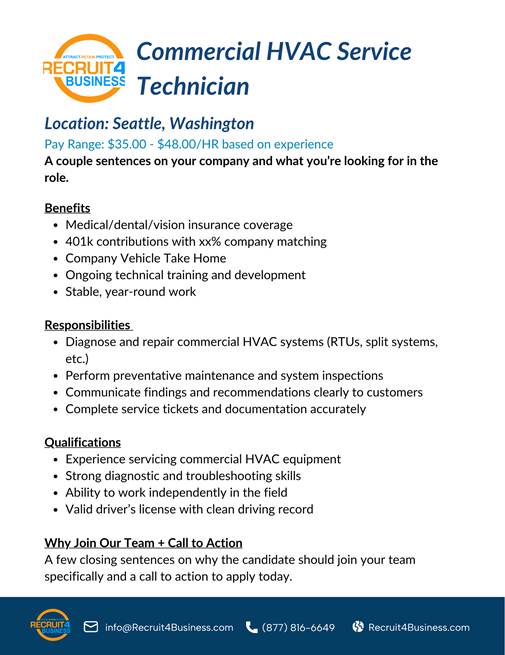
Platforms like Indeed and other job boards prioritize pay transparency. Avoid vague phrases like “competitive pay” and instead list the actual pay range whenever possible.
The job ad shouldn’t include every responsibility from the full job description. When the job ad starts to look more like a novel and less like a skimmable checklist, you’ve lost their attention.
Once completed, the job ad is what gets posted to hiring platforms and shared publicly.
Remember: your job description is the tool you use to create the job ad, but it should also continue serving as an internal document throughout onboarding and employment.
How to Create an HVAC Service Technician Job Description
Every level of technician should have its own job description. A Level 1 Service Technician should not have the exact same expectations, qualifications, or responsibilities as a senior-level technician.
Creating separate job descriptions helps establish career paths, set expectations, and create clearer opportunities for advancement.
What Should Be Included in an HVAC Service Technician Job Description?
A complete job description should include:
- Job title
- Department
- Position the employee reports to
- FLSA status
- Classification
- Work hours
- Pay scale
- Position summary
The position summary should give a high-level overview of the role and its purpose within the company.
Required Qualifications
Next, the job description should outline the required qualifications for the position.
For example, a Level 1 Service Technician may require:
- Valid driver’s license
- Willingness to invest in service tools
- Willingness to invest in service training
- Ability to work independently and with a team
- Strong communication skills
These are the non-negotiable requirements for the role.
Desired Qualifications
You can also include preferred or “nice-to-have” qualifications that may help a candidate stand out but are not necessarily required.
Examples may include:
- EPA Certification
- HVAC trade school certificate
- Prior customer service experience
- Experience with specific HVAC systems or equipment
This section helps identify stronger candidates while still allowing room for trainable applicants to apply.
Essential Functions and Responsibilities
The next section should clearly outline the core responsibilities of the role.
This may include:
- Diagnosing HVAC system issues
- Performing repairs and maintenance
- Communicating with customers
- Completing service documentation
- Following safety procedures
- Maintaining company vehicle and equipment
This section should give employees a clear understanding of what is expected in their day-to-day work.
Success Factors and Competencies
Some companies also include job competencies or success factors to help define what success looks like beyond technical ability.
Examples might include:
- Professional communication
- Time management
- Coachability
- Problem-solving
- Customer service skills
- Reliability
Including these expectations can help create better alignment during both hiring and performance management and give your managers specific metrics to grade their new trainee on.
Physical Demands and Work Environment
Being in the trades, your job description should also include any physical requirements or working conditions associated with the role.
This may include:
- Lifting requirements
- Working in confined spaces
- Climbing ladders
- Exposure to weather conditions
- Driving requirements
This creates clearer expectations and helps protect the company by accurately outlining job demands.
Career Advancement Opportunities
One of the most overlooked parts of a job description is outlining what advancement looks like. It’s not enough to put “job advancement opportunities” of your job ad. The best employers explicitly spell out how each role can advance in their career.
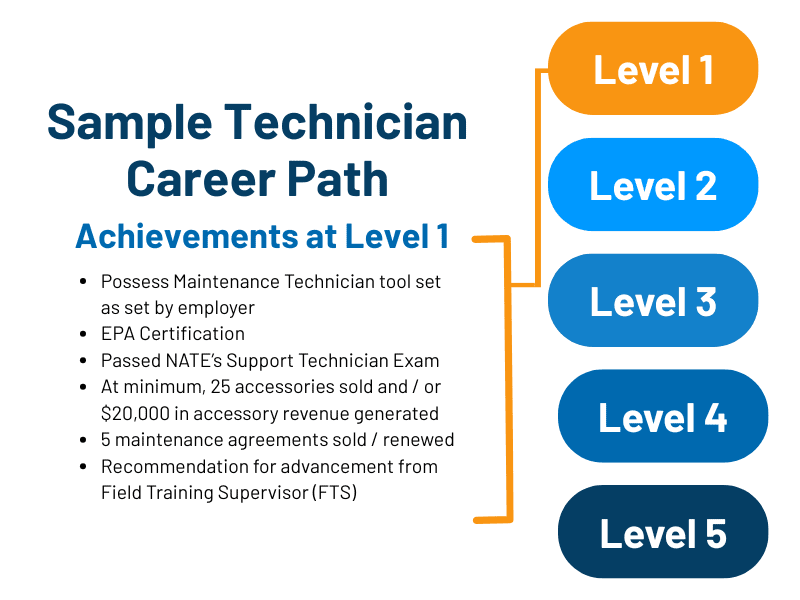
For example, your Level 1 Technician job description may explain what the employee needs to accomplish in order to advance to a Level 2 Technician role.
This can include:
- Training completion
- Certifications
- Performance standards
- Technical skill development
- Customer satisfaction scores
Career pathing helps employees feel like their employer is invested in their individual success and improves employee retention over time.
Why Strong Job Descriptions Matter
A well-written HVAC service technician job description does more than simply explain a role. It helps create structure within your company, set clear expectations, support training efforts, and improve hiring consistency.
When that job description is used to create a concise and compelling job ad, it becomes a much more effective tool for attracting qualified applicants.
Companies that take the time to properly structure both documents attract stronger candidates and make better hiring decisions.
If you need help creating structured job descriptions, improving your hiring process, or attracting stronger HVAC technicians, Recruit4Business would love to help.