
5 of the Best Employee Benefits Besides Pay That Help Attract and Retain Top Talent

Pay matters.
If your wages are significantly below market, a few extra perks won’t solve your recruiting or retention problems. But pay is only one part of what employees consider when deciding where to work and whether to stay.
Employers of choice look at the full employee experience: opportunities to grow, time away from work, company culture, health coverage, retirement benefits, training, flexibility, and what it feels like to be part of the company every day.
That matters even more when you’re competing for experienced HVAC technicians, plumbers, electricians, and other skilled employees who already have plenty of options.
At Recruit4Business, we encourage employers to look beyond salary and ask a bigger question:
Why would a great employee choose to build a career with your company instead of another business down the road?
Becoming an Employer of Choice means creating a workplace where people want to work, grow, and recommend your company to others. Competitive employee benefits are a big part of that. Here are five benefits besides pay that can help you attract and retain top talent.
1. Career Growth, Training, and Certification Reimbursement
One of the most valuable benefits you can offer an employee is a future.

Employees want to know that accepting a job with your company doesn’t mean staying at the same level and doing the same work forever.
Career development can include:
- Defined career paths
- Paid training
- Continuing education
- Certification reimbursement
- Specialty certification support
- Apprenticeship or mentorship programs
- Cross-training
- Leadership development
- Clearly defined opportunities for promotion
Your benefits don’t need to be flashy. Paying for training or certifications that help an employee move forward can mean far more than another short-term perk.
How to Support Employee Career Development in the Workplace
Employee career development is one of the most overlooked retention tools available to employers. Start by making the path forward clear. Every employee should be able to answer:
- Where am I now?
- What do I need to learn?
- What do I need to accomplish?
- What position comes next?
- How does my compensation change as I improve?
Our Employee Career Path Services are built around that exact structure. Career paths give employees a step-by-step plan for how their skills, responsibilities, training, and compensation can grow over time.
Career paths do more than improve employee retention. They give employers a long-term strategy to address the skilled labor shortage by developing experienced employees from within instead of constantly competing for the same limited group of experienced technicians.
That is especially important in the skilled trades. Instead of waiting for the perfect experienced technician to apply, you can hire for potential and train that employee to meet your standards. Think of it as growing your own talent. Employees learn your processes from the beginning, without bringing in bad habits from another employer. When they can clearly see what comes next, they have more reason to build their career with you.
2. PTO, Paid Holidays, and Flexible Scheduling
Employees work to support their lives outside of work, which makes paid time off one of the most practical benefits an employer can offer.
That may include:
- Vacation time
- Sick leave
- Combined PTO
- Paid holidays
- Bereavement leave
- Birthday PTO
- Flexible scheduling
- 4/10 schedules
- Reduced or predictable on-call requirements
- Unpaid leave options when appropriate
If your PTO package is competitive, spell it out in your job ads. Replace vague language like “PTO available” with specifics such as “three weeks of vacation” or “10 paid holidays.” Those details help your company stand out from your competitors.
There is also a big difference between offering the minimum and offering an Employer of Choice benefits package.
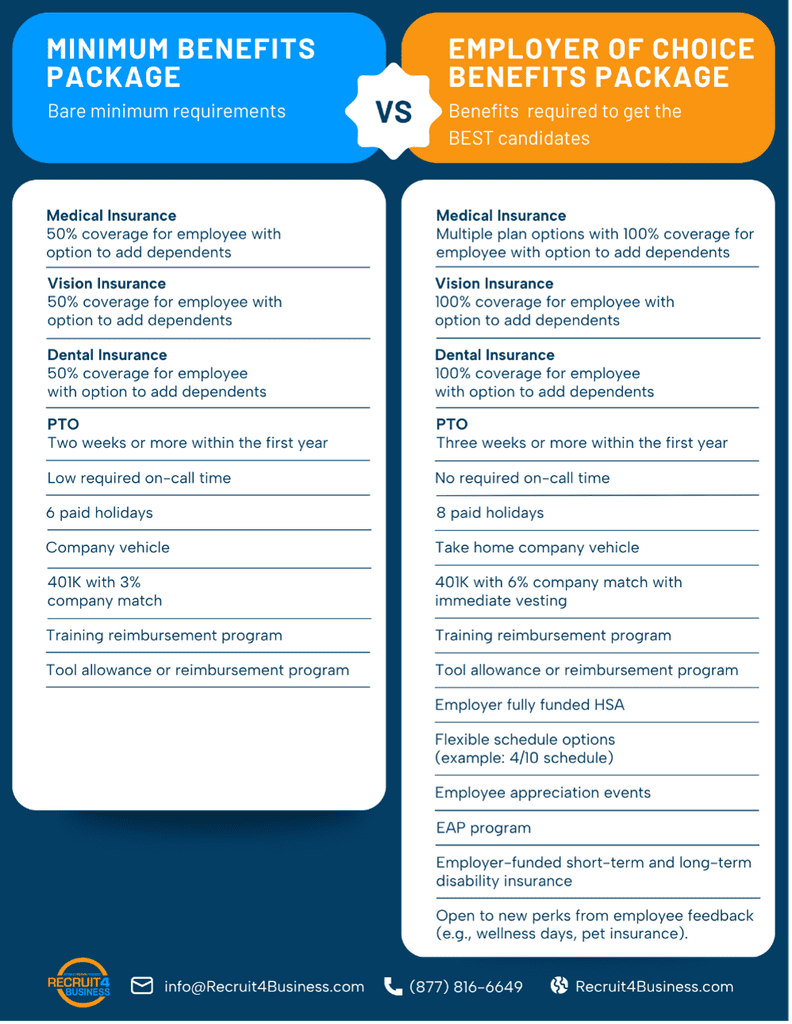
A basic package might include two weeks of PTO and six paid holidays. An Employer of Choice package might offer three or more weeks of PTO in the first year, eight paid holidays, no required on-call time, and flexible options such as a 4/10 schedule. Which company would you rather work for?
3. A Positive Company Culture
Company culture is a benefit you can’t put a price on.
Employees spend about half of their waking weekday hours at work with managers and coworkers. Even the best pay won’t prevent turnover if people regularly deal with poor leadership, weak communication, favoritism, unresolved conflict, or a lack of recognition.
A positive workplace culture can include:
- Respect between employees and leadership
- Managers who know how to lead people
- Clear expectations
- Consistent communication
- Recognition for good performance
- Employee appreciation events
- Opportunities to provide feedback
- Accountability at every level
- Strong onboarding and training
It also means leadership has to live the company’s values. A framed list in the break room means very little when employees see managers behaving differently. Leaders should model the behavior they expect and be held accountable to the same standards as everyone else.
4. Health, Dental, Vision, Disability, and Life Insurance
Health insurance is often one of the first traditional employee benefits candidates compare. But the important question is not simply:
Do you offer health insurance?
Candidates want to know:
How much does the employer contribute?
Employees today expect a meaningful portion of the premium to be covered by employers.
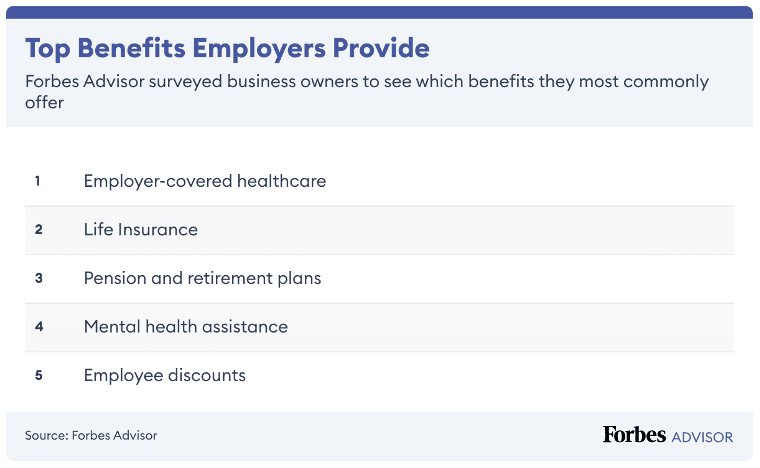
A broader benefits package may include:
- Medical insurance
- Multiple medical plan options
- Dental insurance
- Vision insurance
- Health Savings Account contributions
- Flexible Spending Accounts
- Short-term disability insurance
- Long-term disability insurance
- Life insurance
- Employee Assistance Programs
- Telehealth services
Think about the employee’s total cost
When reviewing your benefits, put yourself in your employees’ shoes. Someone choosing between two jobs with similar pay may compare:
• Monthly premium costs
• Deductibles
• Dependent coverage
• Dental and vision costs
• Disability protection
• Life insurance
• HSA contributions
A slightly higher hourly wage can quickly lose its appeal if the employee has to spend much more on insurance each month. That is why compensation benchmarking should compare both salary and benefits, not salary alone.
We also recommend regularly reviewing the market and your surrounding competition. If other employers offer stronger pay or benefits, your best technicians have little reason to ignore them when they come calling. If you’re struggling to offer competitive benefits, work with an insurance broker to find affordable competitive benefits.
5. A Competitive 401(k) With Employer Match and Immediate Vesting
Retirement benefits may not create the same immediate excitement as a signing bonus, but they send an important message:
We want you to stay here long enough to build a future.
Offering a 401(k) and educating your employees on how to maximize this benefit is a good start. Adding an employer match shows employees that the company is investing in their future. Immediate vesting, or at least a shorter vesting period, can make the plan even more attractive to candidates comparing employers.
What Benefits Do Employees Value Most?
There is no single benefits package that works for every company or every employee. Someone early in their career may value certification reimbursement and career advancement. A parent may care more about health coverage and predictable scheduling. Another employee may prioritize retirement contributions.
That is why employers need to ask employees what they value. Stay interviews, employee surveys, and one-on-one conversations can uncover the benefits your team actually wants.
Employers of Choice stay open to ideas that come from employee feedback. Those benefits don’t always have to be traditional. Depending on your team, valuable options could include certification reimbursement, paid training, corporate discounts, employee appreciation programs, telehealth, gym access, transportation reimbursement, team trips, sporting-event tickets, company-paid memberships, or other unique employee benefits.
You don’t need to offer every benefit on this list. You need the right combination to make your company competitive in your market and valuable to the employees you want to keep.
Build a Full Employment Package to Attract and Retain Your Best Employees
Compensation will always matter, but you don’t have to be the highest-paying employer in town to compete for great employees.
Career growth, competitive benefits, work-life balance, good leadership, training opportunities, retirement security, and a workplace where people actually want to spend their time can all influence whether an employee joins your company and whether they stay.
The strongest businesses approach employee retention the same way they approach recruiting: strategically.
That means:
- Review your salary.
- Review your benefits
- Review your culture.
Then compare the full employee experience you offer with the companies competing for the same people. Remember, if employees can’t see a future with your company, your competitor will show them one.
Recruit4Business helps small and midsize businesses attract, retain, and protect their teams through recruiting, employee retention strategies, salary surveys, career pathing, HR support, and management coaching. If you want help evaluating your employee benefits and identifying ways to become a stronger Employer of Choice, contact Recruit4Business.